


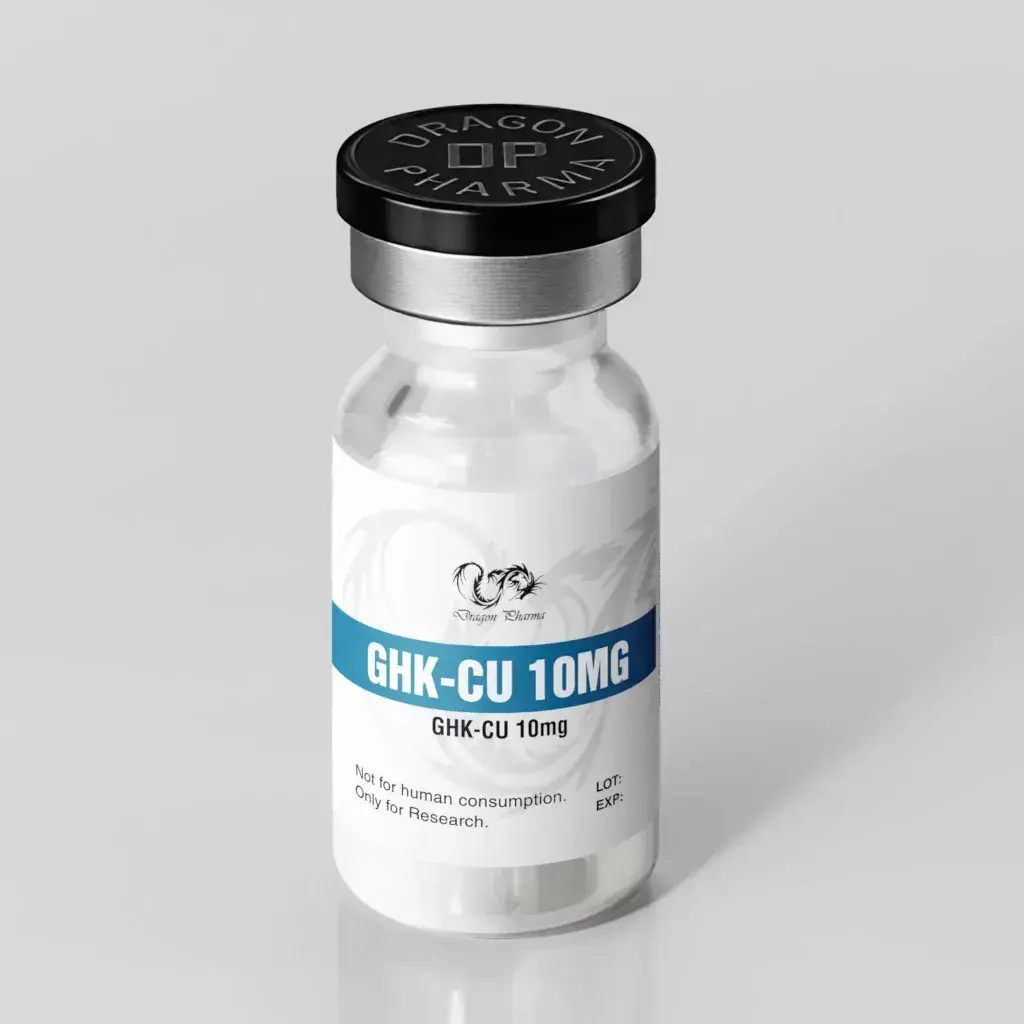
Copper-Binding Tripeptide Complex (Gly-His-Lys)
GHK-CU 10 mg delivers a precisely dosed research-grade copper peptide complex, featuring the tripeptide Gly-His-Lys (GHK) bound to bioactive copper ions. This naturally occurring human plasma peptide, which declines significantly with age, has emerged as one of the most versatile research compounds in regenerative medicine and dermatology. The GHK-Cu complex functions as a master gene regulator, influencing over 4,000 human genes—redirecting cellular activity from aged, diseased patterns toward healthier, more youthful expression profiles. Its distinctive blue color (resulting from the copper-peptide coordination bond) serves as a visual indicator of proper synthesis and purity, making it instantly recognizable to researchers familiar with quality copper peptides.
For bodybuilders, athletes, and skincare researchers in the USA, Dragon Pharma GHK-CU 10 mg offers an optimal concentration for targeted research applications. The 10 mg strength is particularly suitable for studies focusing on topical formulations, localized injection protocols, or combination research where precise peptide ratios are required. Research into GHK-Cu examines its multifaceted effects: stimulating collagen types I, III, and IV synthesis; enhancing elastin production; reducing inflammatory cytokines; promoting angiogenesis (new blood vessel formation); accelerating wound healing; and providing antioxidant protection against oxidative stress. These properties make it invaluable for studies on stretch marks, surgical scars, tendon repair, skin aging, and general tissue regeneration. Manufactured under Dragon Pharma's stringent quality control in certified European facilities, this vial ensures researchers receive a consistently pure, correctly complexed peptide for reliable experimental outcomes.
Key Benefits:
Each 2 mL vial contains 10 mg of high-purity GHK-Cu peptide complex (Gly-His-Lys tripeptide bound to copper ions) as a characteristic blue lyophilized powder, synthesized and purified under Dragon Pharma's pharmaceutical-grade manufacturing standards.
| Product Name | GHK-CU 10 mg |
| Manufacturer | Dragon Pharma |
| Substance | GHK-Cu (Copper Peptide Complex) |
| Packaging | 2 mL glass vial, lyophilized blue powder |
| Lab Test Result | ≥ 98% Purity (HPLC verified with copper coordination) |
| Half-Life | Approximately 2 hours (with cumulative epigenetic effects) |
| Recommended Cycle | Research cycles: 20-60 days for topical/skin studies, 30-90 days for subcutaneous tissue repair models. |
| Form | Lyophilized (freeze-dried) powder for reconstitution |
| Aromatization | Not applicable (non-hormonal peptide complex) |
| Dosage (Research Models) | Studied with various protocols: topical (1-5% formulations), subcutaneous (localized or systemic), and combination approaches. |
Research Application Only: This information summarizes scientific literature for educational context. Dragon Pharma GHK-CU 10 mg is a research chemical for laboratory investigation, not for human consumption.
In experimental settings, GHK-Cu is reconstituted with bacteriostatic water. The blue color upon reconstitution confirms proper copper binding. Research administration routes include: 1) Topical application (mixed into creams, gels, or serums at 1-5% concentrations for skin/wound studies), 2) Subcutaneous injection (for localized tissue repair or systemic effects), and 3) Occasionally intramuscular near injury sites. The 10 mg concentration is particularly convenient for creating precise topical formulations. Research often combines administration methods—for example, systemic plus topical for comprehensive skin studies. Temporary itching at application sites in topical research is normal (histamine response) and part of the healing cascade initiation.
GHK-Cu does not affect hormonal axes, so traditional PCT with SERMs like Toremfine is not applicable. As a gene-regulatory peptide, its effects may persist after cessation. Research protocols might transition to maintenance approaches using lower frequency applications or switch to supporting peptides like BPC-157 for ongoing tissue repair. For comprehensive skin health studies post-cycle, topical antioxidants or higher concentration GHK-Cu could be incorporated into follow-up protocols.
The 10 mg concentration makes GHK-Cu ideal for combination research. For advanced skin rejuvenation studies, it pairs well with AOD 9604 (fat-metabolizing fragment) for comprehensive anti-aging effects. In wound healing models, combining with TB-500 creates a powerful regenerative research protocol. For stretch mark and scar research, adding Retatrutide (for its potential effects on skin remodeling) could be explored. In athletic recovery studies, researching alongside Ipamorelin may enhance growth hormone-mediated repair processes.
Proper storage is essential to maintain the stability and efficacy of this copper-peptide complex.
GHK-Cu is a research copper peptide complex that regulates over 4,000 genes, shifting expression toward healthier patterns. Key research effects include stimulating collagen/elastin synthesis for skin and connective tissue repair, reducing inflammation, accelerating wound healing, promoting new blood vessel formation (angiogenesis), providing antioxidant protection, and helping repair DNA damage from UV/oxidative stress.
Research Use Only: GHK-Cu is for laboratory studies. In preclinical research, dosage varies by application: For topical studies, formulations typically use 1-5% GHK-Cu. For subcutaneous injection in animal models, research might use 0.5-2 mg per site. The 10 mg vial from Dragon Pharma is ideal for creating precise concentrations for various research protocols, including dose-response studies and combination research.
In research models, GHK-Cu demonstrates excellent tolerability. The most common observation in topical studies is temporary itching or mild irritation at the application site, which is actually a normal histamine response that initiates the healing cascade. Systemic administration in animal studies shows good safety profiles. The copper is tightly bound in the complex, preventing copper toxicity at research doses. No hormonal or systemic adverse effects are reported in the scientific literature.
Research timelines vary by application: Gene expression changes occur within hours. Initial wound healing effects may be visible in days in animal models. For collagen synthesis and skin texture improvements, measurable changes typically appear after 4-8 weeks of consistent application in research protocols. The 10 mg concentration is particularly suited for studies requiring precise formulation and shorter testing periods to establish efficacy benchmarks.
The 10 mg concentration is optimized for research requiring precise formulation, topical studies, combination protocols, or projects with budget constraints. The 50 mg version provides more material per vial for extended research, higher concentration formulations, or systemic studies. Both offer the same high purity and proper copper binding. The 10 mg is ideal for researchers testing multiple variables or creating specific concentration gradients in their studies.
Mitochondrial-Derived Peptide
Synthetic Melanocortin Peptide
Official distributor of Dragon Pharma products. Pharmaceutical grade research compounds shipped worldwide.
USA Domestic: 4-5 business days
International: 13-15 business days
Important Disclaimer: All products sold on this website are for research purposes only. They are not intended for human consumption or diagnostic use. These products are not drugs and are not approved by the FDA for the treatment, cure, or prevention of any disease or condition. By purchasing from our store, you acknowledge that you are a qualified researcher and understand the proper handling procedures for these compounds. Keep all products out of reach of children and unauthorized persons.
© 2009 - 2026 Dragon Pharma™. All rights reserved.